


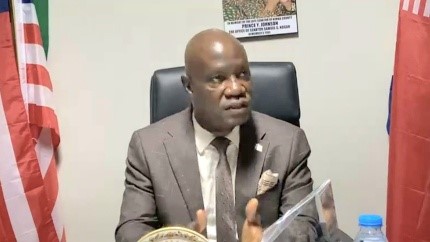
Nimba County Senator Samuel G. Kogar is calling on the Liberian Senate to launch an immediate investigation into what he describes as a clear violation of the 2021 Revenue Sharing Law by the Ministry of Finance in the formulation of the FY2026 National Budget. In his communication addressed to plenary, Senator Kogar said it is unacceptable and economically unfair that counties hosting major mineral concessions—particularly Nimba—are not receiving their legal share of revenues generated from natural resource extraction.
The Senator noted that Nimba County alone is expected to contribute about US$200 million to the national revenue envelope through iron ore operations. However, only US$3 million of that amount has been allotted to Nimba in the proposed FY2026 Budget. Senator Kogar stressed that Chapter 6 of the Natural Resource Revenue Sharing Law clearly mandates that 10 percent of natural resource revenues “shall be transferred directly to the county of origin.” Based on that law, Nimba should be receiving at least US$20 million out of the US$200 million projected from operations in the county, not the US$3 million reflected in the budget draft.
Senator Kogar reminded his colleagues of Liberia’s painful history of “growth without development” during the 1960s, when massive mining activities boosted GDP figures but left mining towns and host communities in ruins, with no sustainable development to show for decades of resource extraction. He warned that failure to enforce the revenue-sharing law would risk repeating historical mistakes, leaving behind what he called “pigpens of mining sites” without tangible socio-economic transformation.
The Nimba County Senator emphasized the legislative responsibility to ensure transparency, accountability, and full enforcement of existing laws, particularly as mineral concessions continue to expand. He referenced the ongoing ArcelorMittal concession extension negotiations, noting that such agreements could commit Liberia to over 50 years of extraction. For that reason, he argued, it is even more urgent for Nimba and other affected counties to receive their lawful share of revenues to undertake long-term and sustainable development projects.
Senator Kogar said that if Nimba receives its rightful US$20 million in accordance with the law, such funds would go toward tangible development investments that would remain long after iron ore reserves are depleted. He compared this to countries such as the United Arab Emirates, which used natural resource revenues to diversify their economies and secure the future of their citizens.
Beyond the issue of revenue sharing, Senator Kogar used his communication and subsequent media engagement to highlight additional challenges facing key institutions in Nimba. He pointed to the G.W. Harley Memorial Hospital—widely regarded as an important referral facility in the region—which is presently attempting to establish new departments, including dental, ocular, autism, and emergency units. According to the Senator, the hospital lacks adequate funding to properly operationalize these units, and he is requesting at least US$150,000 to be added to the national budget as initial support to strengthen the hospital’s services.
Addressing concerns regarding the county’s ability to tap into its Social Development Fund (SDF), he explained that the SDF is meant for county-level development, not for funding government-owned assets such as hospitals, administrative buildings, or schools. He stressed that while counties can use their SDF for emergencies—such as during the Ebola crisis—it remains the central government’s responsibility to maintain core public institutions.
When asked about the effectiveness of his advocacy, Senator Kogar said he and other Nimba lawmakers are working collaboratively, with each playing a specific role. He stated that Representative Samuel G. Wamah for Nimba County serves on the Ways, Means, and Finance Committee, making him a key actor in ensuring that budgetary corrections are made to reflect the law. According to him, the communication he submitted will strengthen the collective push for compliance with the revenue-sharing law.
The Senator concluded his remarks by reaffirming that the law must be applied across all counties with natural resource operations—not only Nimba. He insisted that the Ministry of Finance has no authority to selectively apply or ignore statutory mandates, and urged the Senate’s Committees on Judiciary, Ways, Means, and Finance to thoroughly investigate and ensure that every component of the 2021 Revenue Sharing Law is fully captured in the national budget.
Senator Kogar’s communication ends with a plea for urgent plenary action, stating that enforcing the 10 percent allocation is not only a legal obligation but also a moral responsibility to ensure fairness and development for communities whose natural resources continue to drive national revenue.