


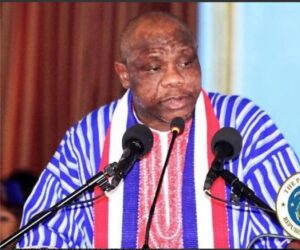



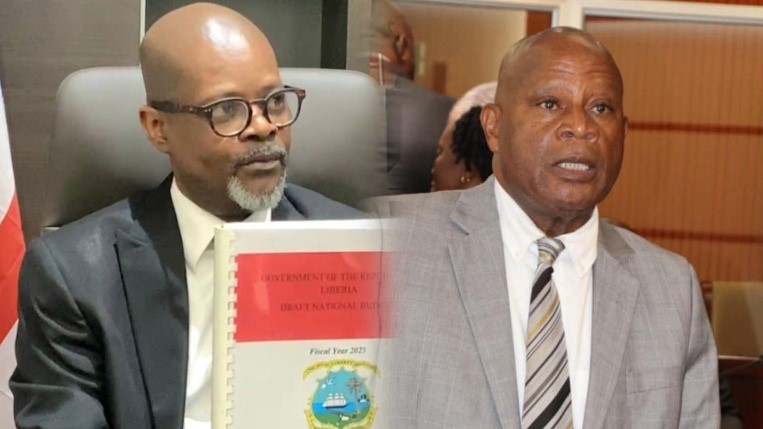
Division of views has emerged between two Senators over whether the Senate is constitutionally permitted to conduct budget hearings while the House of Representatives is carrying out its own review of the Draft National Budget for Fiscal Year 2026. The disagreement, which now sits at the center of a wider debate, pits Montserrado County Senator Abraham Darius Dillon against Grand Sinoe County Senator Augustine Chea, Chair of the Senate’s Judiciary, Claims and Petitions Committee.
This comes shortly after Senator Dillon publicly dismissed claims that the Senate is in constitutional violation by holding independent hearings on the national budget. His defense came in response to a complaint filed by Nimba County District #7 Representative and CMC Political Leader Musa Hassan Bility, who petitioned the House of Representatives to halt the Senate’s ongoing budget scrutiny.
Dillion’s statement was in response to Rep. Musa Bility, in whose communication, argued that the Senate’s actions undermine legislative order and risk plunging the Legislature into what he called “procedural chaos.” Citing Article 34(d)(i) of the 1986 Constitution, he emphasized that all revenue and fiscal bills must originate exclusively in the House of Representatives. According to him, the Senate’s decision to conduct public budget hearings before the House has completed its formal review amounts to assuming constitutional powers that the Senate does not possess. He stressed that only after the House debates, amends, and passes the draft budget should the Senate begin its own deliberations.
Bility warned that the ongoing Senate hearings could create institutional conflict, legislative disorder, and constitutional uncertainty. He maintained that the national budget—described as the government’s most important instrument—must be managed strictly within constitutional procedures to maintain public confidence. Anything outside those boundaries, he said, risks eroding trust in the Legislature’s integrity. The House is expected to examine his petition in the coming days.
Senator Augustine Chea, the Senate’s Committee on Judiciary Chairman aligned partly with Bility’s position. Chea stated unequivocally that the House of Representatives is correct that the Senate cannot undertake formal deliberations on the national budget until the House has reviewed and passed the engrossed bill. He reinforced the constitutional provision that vests the initial stage of the budget process solely in the House. However, Chea clarified that nothing in the Constitution prevents the Senate from holding informal or preliminary engagements—including consultative hearings with ministries, agencies, and commissions—to prepare for its eventual review. He argued that such activities are not formal legislative action and can even improve the timeliness of budget passage.
But Senator Dillon rejected Bility’s petition and any interpretation suggesting wrongdoing by the Senate. Speaking during an extensive media engagement at the Capitol, Dillon described Bility’s assertions as the result of a “profound misunderstanding” of both constitutional law and legislative practice. He argued that the Senate is not attempting to pass or approve the budget ahead of the House; rather, it is gathering information, promoting transparency, and conducting due diligence—activities he insists are not restricted by the Constitution.
Dillon pointed to decades of precedent under presidents Charles Taylor, Ellen Johnson Sirleaf, George Manneh Weah, and Joseph Nyuma Boakai. He noted that every administration has submitted the national budget to both chambers simultaneously, with the President’s communication always addressed to both the Speaker and the Senate President Pro Tempore. This, he argued, demonstrates that the Senate has always been treated as an active participant from the very beginning of the budget process.
He further explained that the Senate has independently held budget hearings multiple times in previous years, including in 2021 when he personally moved for such separate scrutiny. Joint hearings between the House and Senate, he said, have been customary only to speed up the process—not because of any constitutional limitation on the Senate.
Dillon insisted that transparency remains the central reason behind the Senate’s continued hearings. He highlighted noticeable increases in allocations to several sectors, including security, university education, regulatory agencies, agriculture, and key ministries. According to him, the public deserves clarity on how funds are distributed, which institutions have benefited, and which have been left behind. He argued that such scrutiny strengthens, rather than undermines, public trust.
The Montserrado County Senator also emphasized that the Senate is not working at cross-purposes with the House. He revealed that the two chambers have coordinated appearance schedules for ministries and agencies to avoid conflicts and ensure smooth proceedings. According to him, nothing the Senate is doing obstructs the House’s constitutional role; instead, both chambers are fulfilling their responsibilities in parallel without breaching any constitutional requirement.