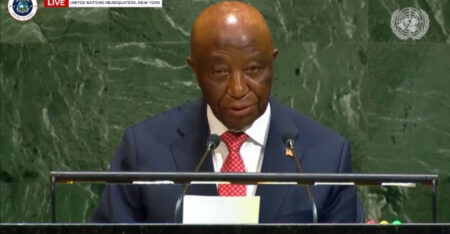






Isaac Doe, former CDC Deputy Youth and Sports Minister, is urging the 55th National Legislature to reject President Joseph Boakai’s reported plan to print more Liberian dollars.
Doe described the move as “dangerous and politically driven,” warning that it could trigger inflation and further weaken the economy. He also cast doubt on the Legislature’s independence, saying he expects lawmakers to side with the President despite the risks.
He stressed that the 2021 currency change under former President George Weah was a replacement exercise, not an expansion of the money supply meant to strengthen monetary control and remove old notes from circulation.
According to Doe, printing money now is not a solution but a shortcut that will hurt ordinary Liberians, while calling for real economic reforms.
Here is a statement of an opposing economic and financial view to Boakai’s printing of more money by Isaac Doe:
“Liberia stands at a fragile economic crossroads where disciplined policy choices, not the printing of more money should drive both short and long-term stability. No well-structured economy treats the printing of additional banknotes as a credible solution to liquidity constraints (if the government will admit to one). In fact, such actions often deepen the very problems they claim to resolve. With this, let me quickly address an argument I expect from supporters of the Unity Party. The 2021 monetary action under George Weah was fundamentally different. That exercise involved replacing old banknotes with an entirely new currency family, a move that was necessary to improve monetary control, enhance currency integrity, and tighten policy oversight at a time when huge amounts of currency were being held outside the financial system. It was a structural adjustment to earlier financial control weaknesses from past administrations, not an expansion of the money supply.
By contrast, printing more of the same banknotes, as the Boakai government intends, does not reform the system. It only adds additional money without addressing underlying economic weaknesses. Such a measure risks fueling inflation, weakening confidence in the currency, and eroding purchasing power.
Ultimately, the government’s four-point justification for printing additional banknotes fails to align with available economic data and established monetary principles. A prudent and thorough Legislature should recognize these risks and act in ways that safeguard the Liberian economy by rejecting this approach, even if political realities suggest otherwise.
In its justification, the government argues that the need for more money is driven by replacement of mutilated banknotes, expansion demand due to a growing economy, a gold purchase program as a reserve backer, and de-dollarization. However, these arguments do not hold strong economic or financial merit.
(1) Replacement of Mutilated Banknotes Does Not Justify Expansionary PrintingIn late 2025, the Central Bank of Liberia reported that approximately L$1 billion of the 2021 banknotes in circulation are damaged or mutilated, representing just 3.4% of total currency in circulation. From a monetary policy standpoint, this is a routine currency management issue, not a justification for expanding the money supply.
Standard central banking practice dictates that mutilated notes are replaced on a one-for-one basis, ensuring no net increase in money supply. Any move beyond this, particularly large-scale printing, signals either policy inconsistency or undisclosed monetary objectives. Therefore, using mutilated currency as a basis for printing additional money lacks economic credibility and warrants legislative scrutiny.
(2) Gold Reserve Accumulation Does Not Require Monetary ExpansionThe proposal to strengthen reserves through gold acquisition is, in principle, a sound macroeconomic strategy. However, financing such purchases through the printing of more money introduces inflationary risk and undermines the very stability reserve accumulation seeks to achieve.
Moreover, the Gold Reserve Act of 2026, introduced by Rivercess Senator Bill Tweahway, which mandates a 1% royalty in gold to the Central Bank of Liberia, already provides a non-inflationary and non-cash purchase mechanism for reserve accumulation. This weakens any argument that money printing is necessary to support gold purchases.
In economic terms, reserve accumulation should be sterilized, not inflation-financed. Printing more money to buy gold effectively expands liquidity without corresponding productivity gains, an approach inconsistent with sound monetary management.
(3) Excess Liquidity Already Exists in the SystemCentral Bank data indicates that of the L$48.734 billion printed between 2021–2022, only about L$28 billion is currently in circulation. This implies that over L$20 billion remains outside active circulation.
Furthermore, the government’s stated push toward a digital and cash-lite economy directly contradicts the rationale for expanding physical currency. Increasing supply while promoting reduced cash usage reflects policy inconsistency rather than genuine market demand.
(4) De-dollarization Is a Long-Term Structural Reform, Not a Short-Term JustificationDe-dollarization is a complex and gradual process that requires macroeconomic stability, institutional credibility, and strong policy coordination. It carries significant risks, including capital flight, exchange rate volatility, and reduced investor confidence if poorly managed.
Given these realities, de-dollarization is inherently a long-term objective, likely requiring years, if not a decade, of phased implementation. Using such a distant policy goal to justify immediate large-scale money printing is economically unsound.
Conclusion: A Case Against More Money PrintingThe proposed printing of additional banknotes is not supported by fundamental economic indicators or sound monetary policy principles. Instead, it presents clear risks:Inflationary pressures from excess liquidityCurrency depreciation due to weakened confidenceErosion of monetary disciplineIncreased vulnerability to fiscal misuse and corruptionPolicy decisions of this magnitude must be grounded in transparency, data, and economic discipline, not convenience. The Legislature should therefore critically evaluate and reject the proposal to print more money without a clear, evidence-based justification.