

By: Wilmot Konah
A new investigation by global watchdog “The Sentry” has unveiled a series of serious allegations against Ivanhoe Mines—the company seeking investment in Liberia, accusing the company of unlawfully extending mining licenses, manipulating regulatory processes, and engaging in questionable partnerships with politically exposed individuals in the Democratic Republic of Congo (DRC).
According to the report, Ivanhoe allegedly illegally retained expired exploration permits far beyond the 15-year limit set by the Congolese Mining Code. In one instance, the Ministry of Mines reportedly granted extensions just a day before the permits were set to expire, a move the report says is not authorized under existing laws.
“The Congolese Mining Code explicitly limits exploration permits to 15 years… Yet Ivanhoe’s permits were extended beyond this legal maximum,” the investigation noted.
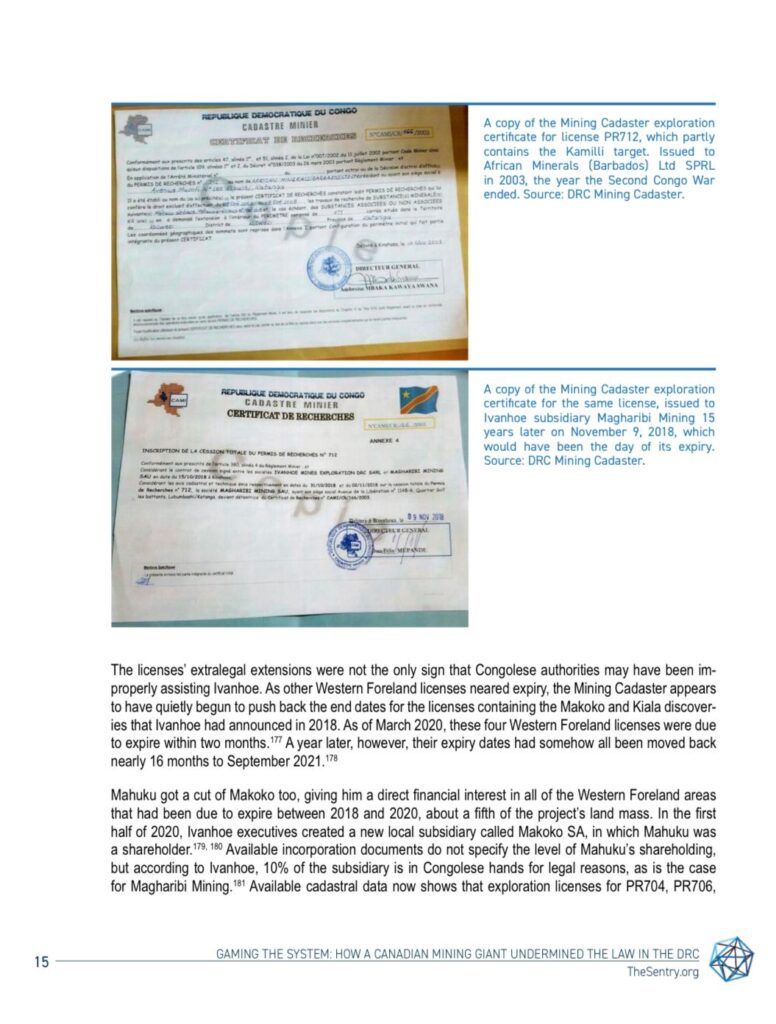
The Sentry further alleges that Ivanhoe repeatedly abused the permit transfer system to “reset” expiring licenses. Newly formed subsidiaries — including Magharibi Mining and G12 Enterprise — received control of nearly expired permits within days of their incorporation, despite no legal provision allowing expired licenses to be revived through transfers.
“Nothing in the Mining Code allows an expired permit to be renewed through a transfer—yet that is exactly what occurred,” the report said.
A major part of the investigation centers on collusion with the political network of former President Joseph Kabila, particularly through Théophas Mahuku. The report states that Mahuku, described as a close associate of Zoé Kabila, was given a secret 10% stake in Magharibi Mining.
The Sentry says these shareholder deals created financial incentives for officials to act in Ivanhoe’s favor, despite legal restrictions.At the same time, the report accuses Ivanhoe of misrepresenting its ownership structure to investors, maintaining public claims of 100% ownership even after transferring shares to politically exposed partners.
The watchdog warns this failure to disclose material changes may raise securities law concerns in Canada and the United States.The Sentry also highlights what it calls undue influence over the mining registry (CAMI), citing unusually rapid processing of Ivanhoe’s applications — some completed in just six days compared to an average of nearly 300 days.
Investigators say CAMI officials even altered permit expiration dates without legal justification, suggesting possible political interference.The company’s record stretches back years: a 2007 government committee reportedly accused Ivanhoe of submitting forged documents during a dispute with another mining firm, Anmercosa.
The report says the findings were suppressed, preventing legal action. For nearly two decades, Ivanhoe is also accused of violating the “use it or lose it” rule, holding vast tracts of land with minimal exploration activity since as far back as 2003.
The watchdog argues this behavior undermines the core purpose of the regulation, which is to prevent land hoarding. Internationally, the company faces even more scrutiny. Canadian authorities have reportedly launched a criminal probe into potential foreign bribery linked to Ivanhoe’s dealings in the DRC.
The Sentry says these activities also raise classic red flags under the U.S. Foreign Corrupt Practices Act (FCPA). The investigation goes on to allege secretive share transfers to politically connected intermediaries who contributed no capital, expertise, or visible services.
The Sentry asserts these arrangements appear designed to enrich politically aligned actors rather than serve legitimate business purposes.Finally, the report claims Ivanhoe attempted to convert irregular exploration licenses into long-term production permits, despite lacking required feasibility studies and environmental assessments. If approved, these conversions would have granted the company 25-year production rights based on licenses allegedly obtained through unlawful processes.
The Sentry’s findings have intensified calls for stronger oversight in the DRC’s mining sector, as global attention turns once again to issues of governance, transparency, and political influence in one of the world’s most mineral-rich regions.
