





By: Melvin Jackson
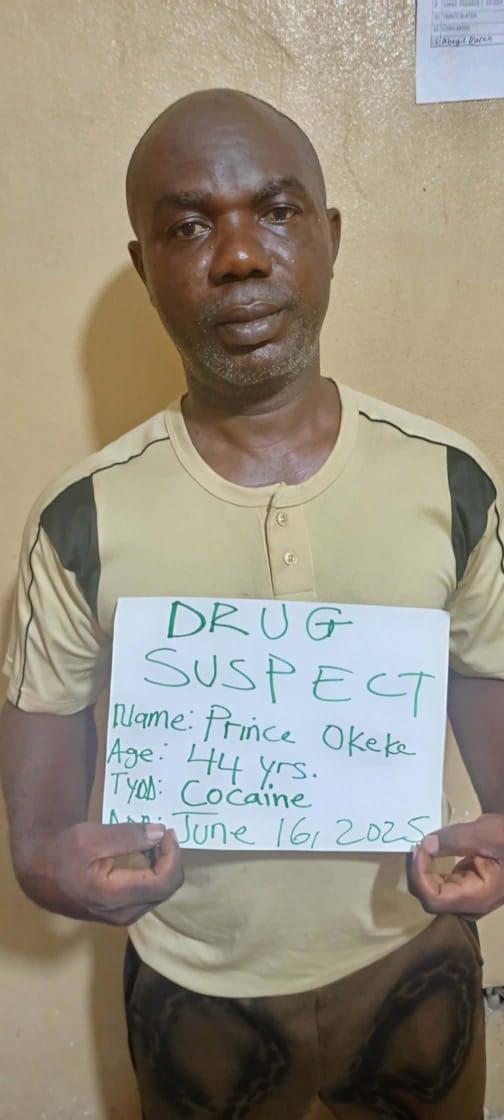
Nigerian national Prince Okeke has been convicted by the 13th Judicial Circuit Court in Margibi County in one of Liberia’s most high-profile narcotics cases.
The court, presided over by Resident Circuit Judge Victoria Worlobah Duncan, on Wednesday handed down a guilty verdict against Okeke, finding him liable for Unlicensed Importation, Illicit Trafficking of Controlled Drugs, Criminal Conspiracy, and Criminal Facilitation.
According to our judicial correspondent, the ruling highlights the court’s willingness to rely on strong, corroborated circumstantial evidence to dismantle organized drug networks using Liberia as a transit corridor.
The case centered on the importation of more than eight kilograms of raw heroin through Roberts International Airport (RIA), with an estimated street value of nearly US$389,000. Prosecutors told the court that the operation involved multiple actors, covert coordination, and deliberate efforts to evade law enforcement, identifying Okeke as the local coordinator assigned to receive and assist couriers arriving from overseas.
In her judgment, Judge Duncan declared: “Wherefore and in view of the foregoing facts and circumstances, the Defendant, Prince Okeke, is hereby adjudged guilty of the crimes of Unlicensed Importation, Illicit Trafficking of Controlled Drug or Substance, Criminal Conspiracy and Criminal Facilitation.”
The court relied heavily on Okeke’s conduct after being summoned by the Liberia Drug Enforcement Agency (LDEA), noting his prolonged disappearance, the switching off of his mobile phone for more than four months, and his inconsistent and uncorroborated statements. These, the judge ruled, amounted to compelling circumstantial evidence of guilt.
Quoting Supreme Court precedent, the court held that “flight by a defendant is treated as strong circumstantial evidence of guilt and carries with it a presumption of consciousness of guilt,” making it sufficient to sustain a criminal conviction when supported by other evidence.
Judge Duncan said the prosecution’s case went far beyond mere suspicion. Two co-accused, Arondo L. Bonancy and Abel S. Gbedia, were arrested at RIA with 8.642 kilograms of raw heroin concealed in their luggage. In voluntary statements, both consistently identified Okeke as the person who coordinated their airport reception and facilitated the movement of the drugs.
The court further noted that Okeke admitted knowing Abel, provided him financial assistance after the arrest, and failed to give any credible reason for ignoring law enforcement, all of which strengthened the prosecution’s case.
Emphasizing that drug syndicates rarely leave direct evidence linking coordinators to contraband, the judge said courts must rely on patterns of conduct, corroborated testimonies, evasive behavior, and the allocation of roles within a criminal enterprise. Citing precedents, including Jusu v. Republic and Republic of Liberia v. George Obi, she affirmed that “circumstantial evidence, when corroborated, is as strong and probative as direct evidence.”
The court also found Okeke’s defense implausible. He claimed to be an herbal drink seller but provided no proof, denied involvement in airport operations despite contrary evidence, and could not explain why his registered GSM number was in another person’s name. These contradictions, the judge ruled, were deliberate attempts to conceal his true role.
Concluding that Okeke was an active participant in a criminal conspiracy to traffic heroin through Liberia, the court scheduled sentencing for January 23, 2026, pending a presentence investigation report from the Probation Office. Okeke has since noted an appeal to the Supreme Court of Liberia, which has suspended further proceedings pending appellate review.


