

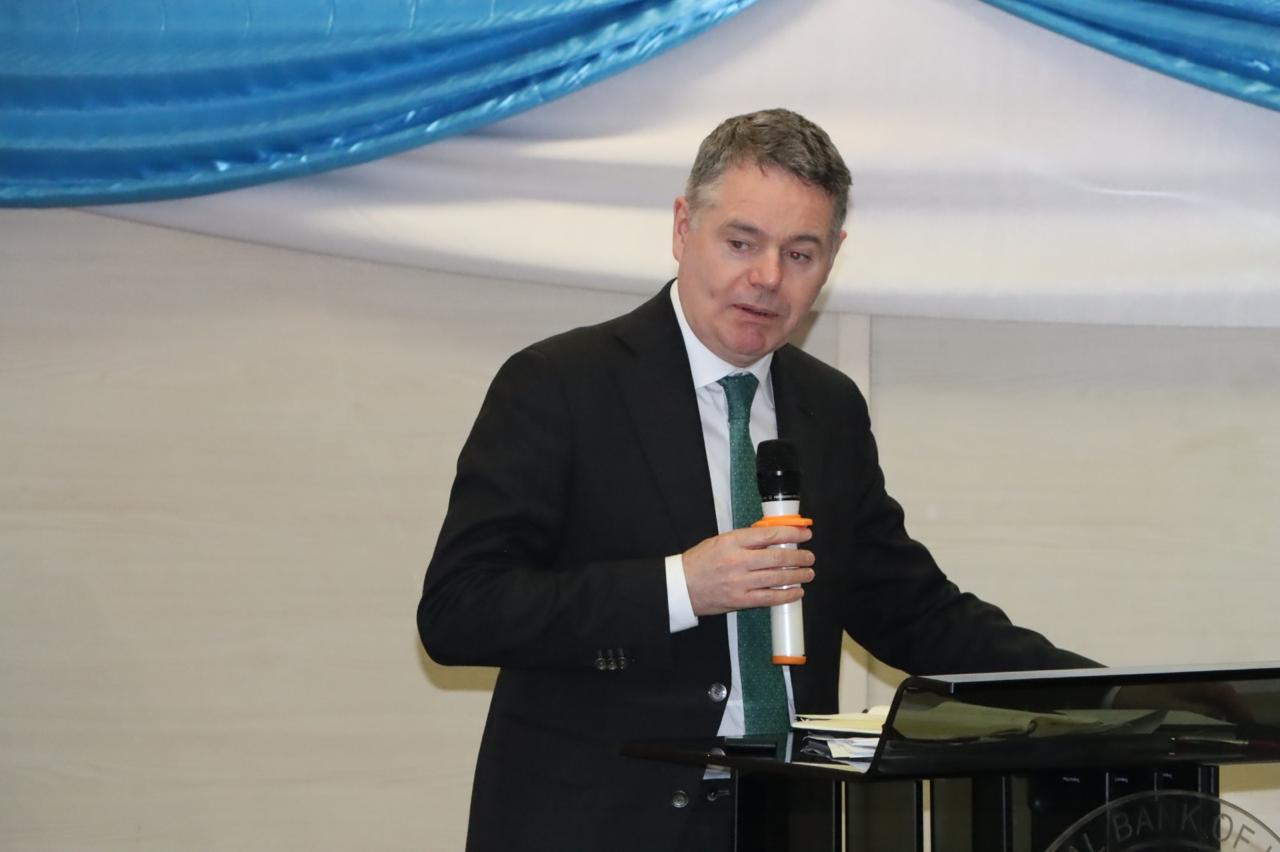
Monrovia, March 23, 2026 – The World Bank Group Managing Director and Chief Knowledge Officer, Pascal Donohoe, has commended the Central Bank of Liberia (CBL) for progress in monetary stability, banking strength, and digital financial inclusion, describing the developments as “a great moment of opportunity” despite global economic uncertainties.
Mr. Donohoe made the remarks during a March 20 visit to the CBL headquarters in Monrovia—his first trip to West Africa since assuming office in November 2025. He praised Liberia’s reforms and emphasized the importance of private sector growth, stating that “the private sector is essential for job creation,” especially in an economy where about 90% of businesses employ fewer than eight people.
He also highlighted ongoing support for small and medium-sized enterprises (SMEs), noting progress under the LIFT Project, which has “deployed USD 6 million through seven institutions to over 200 SMEs,” with 40% of beneficiaries accessing commercial credit for the first time. He added that “strong tax revenues alone cannot succeed without private sector dynamism,” underscoring the need for continued investment in business development.
Mr. Donohoe further pledged the World Bank’s backing for key reforms, including the CBL’s Credit Reference System, set for launch in April 2026, and insolvency reforms aimed at strengthening the financial sector.
Welcoming the delegation, CBL Executive Governor Henry F. Saamoi said the Bank has made “significant progress in strengthening macroeconomic stability and advancing financial sector reforms.”Governor Saamoi reported a steady decline in inflation, noting that “prudent monetary policy has contributed to a stable and predictable inflation environment,” with inflation falling to 4 percent at the end of December 2025—the first such level in nearly two decades. He added that inflation further declined to 3.2 percent in January 2026 and 3.1 percent by the end of February.
He also highlighted improvements in the banking sector, stating that “enhanced supervision, stronger regulatory compliance, and improved risk management practices” have led to a sharp reduction in non-performing loans, which dropped from 21.6 percent in January 2025 to 12.79 percent by February 2026.
On currency management, Governor Saamoi said the introduction of new Liberian banknotes “has strengthened public confidence in the currency and improved the efficiency of cash transactions nationwide.”Turning to digital financial services, he described the Liberia Instant and Inclusive Payment System (IIPS) as a major milestone, noting that it has recorded over 1.53 million transactions valued at approximately LRD 1.43 billion and USD 9.03 million within just three months of operation. He emphasized that these figures were achieved through “only two initial use cases—person-to-person and government-to-person payments.”
Governor Saamoi also disclosed that the CBL is advancing the National Electronic Payment Switch to “integrate all financial sector players into a unified and efficient payments ecosystem.”In addition, he pointed to governance reforms, including strengthened internal controls and transparency measures, which have enabled the CBL to record operational surpluses in 2024 and 2025. He described this as “the first time in over two decades,” reflecting improved financial discipline and institutional efficiency.
Both officials said continued reforms, stronger partnerships, and private sector expansion will be key to sustaining Liberia’s economic gains and building resilience against global challenges.
