

…Says It Cripples Social & Infrastructure Development…
The Executive Governor of the Central Bank of Liberia (CBL), Henry Saamoi, has issued a strong caution to ECOWAS Member States against the growing burden of high recurrent expenditure, warning that excessive spending on wages, overheads, and consumption continues to undermine critical investments in infrastructure and social development across the sub-region.
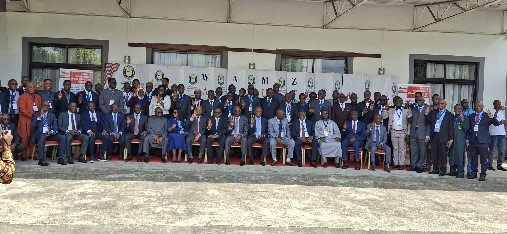
Governor Saamoi sounded the warning while delivering a welcome address at the joint opening ceremony of the 67th Ordinary Meeting of the Committee of Governors of Central Banks of ECOWAS Member States (WAMA), the 52nd Meeting of the Committee of Governors of the West African Monetary Zone (WAMI), and the 50th Board of Governors’ Meeting of the West African Institute for Financial and Economic Management (WAIFEM), held in Monrovia.
Speaking before a high-level gathering of central bank governors, parliamentarians, representatives of regional and international institutions, and members of the diplomatic corps, the CBL Governor emphasized that while fiscal performance in the region has improved, recurrent expenditure continues to consume a disproportionate share of national budgets.
“Recurrent spending continues to absorb a large share of budgets, leaving limited fiscal space for the infrastructure and social investments that our economies require,” Governor Saamoi stated, describing the trend as a structural challenge that demands difficult but necessary political decisions across ECOWAS Member States.
According to him, unless governments deliberately rebalance spending priorities toward capital investments, the region risks slowing its development momentum despite recent macroeconomic gains.
Governor Saamoi’s address came against the backdrop of global economic uncertainty, marked by geopolitical tensions, climate shocks, and technological disruptions. He noted that global growth remained steady at about 3.3 percent in 2025, while inflation has been trending downward globally, albeit with persistent vulnerabilities in many developing economies.
Despite these headwinds, he said the ECOWAS region has demonstrated notable resilience. Regional economic growth rose to 4.5 percent in 2025 from 4.4 percent in 2024, with projections pointing to a stronger 5.0 percent growth in 2026.
“This performance is no accident,” Saamoi stressed. “It reflects deliberate policy choices, improved coordination among our central banks, and reform efforts undertaken by Member States despite difficult domestic circumstances.”
He further disclosed that inflation across the region declined significantly from 23.3 percent in 2024 to 16.8 percent in 2025, with further moderation expected, even though the figures remain above the agreed convergence target.
While applauding the narrowing of the consolidated fiscal deficit to 3.1 percent of GDP in 2025 from 4.8 percent in 2024, the CBL Governor cautioned that expenditure pressures remain intense.
He explained that although enhanced revenue mobilization—driven by improved tax administration, customs reforms, and non-tax revenue collection—has yielded positive results, the dominance of recurrent expenditure continues to crowd out productive investments.
“This is a structural issue that will require sustained attention and, in some cases, difficult political choices about expenditure priorities and revenue enhancement,” he said.
On debt sustainability, Governor Saamoi noted cautious improvements, with the regional debt-to-GDP ratio projected to decline to 42.3 percent in 2025. However, he warned that debt servicing obligations remain heavy for several Member States, calling for continued reliance on concessional financing and stronger debt transparency frameworks.
Turning attention to Liberia, Governor Saamoi reported that the country’s economy grew by an estimated 5.1 percent in 2025, up from 4.0 percent in 2024, outperforming both the regional and global averages.
He attributed this growth largely to strong performance in the industrial and mining sectors, particularly iron ore and gold exports, which recorded a 17 percent growth in 2025.
Inflation in Liberia, he acknowledged, posed challenges early in the year but eased significantly following strong coordination between monetary and fiscal authorities. Average inflation stood at 8.5 percent in 2025, while end-period inflation declined to 4 percent.
The CBL Governor also highlighted Liberia’s strong fiscal discipline, noting that government revenue and grants rose by 18.6 percent in the first half of 2025, enabling the country to achieve a balanced budget within the ECOWAS threshold. Public debt declined to 54.2 percent of GDP, placing Liberia among the better-performing countries under the convergence criteria.
Liberia’s external sector also recorded robust gains, with exports increasing by over 30 percent and gross external reserves rising to US$575.5 million. The Liberian dollar remained largely stable, depreciating by just 0.9 percent against the US dollar in 2025.
Governor Saamoi acknowledged significant progress toward the ECOWAS single currency project, including agreement on capital requirements for the proposed Central Bank of West Africa (CBWA) and readiness of key legal frameworks.
However, he expressed concern over unresolved bottlenecks, particularly the failure to agree on the host country for the CBWA headquarters and delays in implementing the ECOWAS Payment and Settlement System (EPSS), largely due to funding constraints.
“These delays have implications for the 2027 timeline for the launch of our single currency, the ECO,” he warned, urging stronger political commitment to resolve outstanding issues.
Throughout his address, the CBL Governor repeatedly underscored the importance of unity, discipline, and solidarity in achieving regional integration. Quoting prominent African and global leaders, he reminded delegates that economic integration is not optional but essential for West Africa’s survival in a globalized world.
“The people of West Africa are watching us,” Saamoi concluded. “They expect us to deliver on the promise of regional integration not through rhetoric, but through concrete actions that improve their lives.”
He urged ECOWAS leaders to confront the challenge of excessive recurrent expenditure head-on, stressing that without deliberate fiscal reorientation, the region’s aspirations for inclusive growth, infrastructure expansion, and a successful monetary union could remain elusive.
