

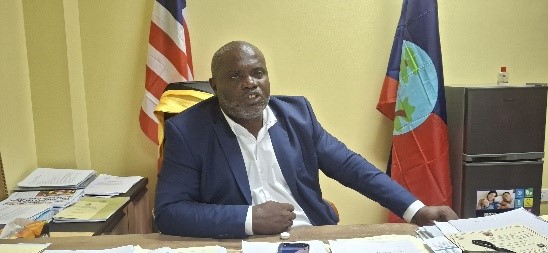
Montserrado County Senator and Chairman of the Senate Committee on Transport, Saah H. Joseph, has described the Ivanhoe Atlantic Concession and Access Agreement (CAA) as a “bad deal” that undermines Liberia’s national interest, even as the Liberian Senate has proceeded to concur with the House of Representatives on the ratification of the agreement.
Senator Joseph, who headed a joint committee tasked with reviewing the Ivanhoe rail and access concession, made the remarks following a tense Senate session on Thursday, during which Plenary constituted itself into a Committee of the Whole. In doing so, the Senate effectively set aside the joint committee’s report on grounds that it did not secure required two-thirds signatures of its members, a procedural deficiency that paved the way for concurrence with the House and eventual ratification of the concession.
Speaking late Thursday evening from his Capitol Building office, Senator Joseph expressed deep disappointment with what he described as the Senate Plenary failure to uphold its oversight responsibility and protect the Liberian people from repeating historical mistakes associated with concession agreements.
According to the Montserrado lawmaker, the joint committee comprising the Committees on Transport, Public Works, Concessions and Investment, Ways, Means, Finance and Budget, Public Accounts and Audits, and Judiciary was mandated to conduct due diligence on the agreement between the Government of Liberia and Ivanhoe Atlantic, a deal that provides the company with access to Liberia’s rail and port infrastructure for the transshipment of iron ore from neighboring Guinea over a 25-year period.
Senator Joseph disclosed that throughout the review process, the committee repeatedly requested critical documents from the Executive Branch, particularly evidence of formal consent and coordination from the Government of Guinea, given that the project’s viability depends almost entirely on Guinean iron ore transiting Liberian territory. He noted that many of those documents were never submitted, despite assurances from relevant ministries.
“We asked for documents to do our due diligence. Some of those documents were never provided,” Senator Joseph said. “Most importantly, there was no documentary evidence of consent or authorization from the Guinean authorities for operations from Guinea into Liberia.”
Despite these deficiencies, the committee proceeded to conduct a public hearing, during which several concerns were raised by lawmakers, civil society actors, and affected communities. Out of those deliberations, the joint committee formulated a set of recommendations which, according to Senator Joseph, were aimed at safeguarding Liberia’s infrastructure, environment, and affected communities.
Among the key recommendations was a requirement that Ivanhoe fully pave the road in Nimba County connecting the Guinean border to Liberia before commencing any large-scale haulage. Senator Joseph recalled that communities in mining regions have historically protested against excessive dust, road damage, and environmental degradation caused by concessionaires who rely on laterite roads without paving them.
“We have seen this movie before,” he said. “Other companies promised roads and rail but later said it was not in the concession. This time, we wanted it written clearly so the company could be held accountable.”
The committee also recommended that Ivanhoe be given a strict two-year timeframe to construct the rail line connecting the Guinean mine to the Tokadeh rail system, arguing that vague commitments without timelines have allowed past concessionaires to delay critical infrastructure indefinitely while continuing to benefit from Liberian assets.
Another contentious issue was the access fee stipulated in the agreement, reportedly ranging between US$1.55 and US$1.95 per metric ton. Senator Joseph and other committee members argued that the fee was far too low considering the strategic value of Liberia’s rail and port infrastructure. The committee suggested that the government renegotiate the fee to a range of US$2 to US$3 per ton.
Additionally, the committee challenged the classification of approximately US$37 million already paid by Ivanhoe to the Liberian government, including a US$7 million payment made under a previous administration. The committee insisted that the amount should be deemed a non-refundable signature bonus rather than a loan or advance that could later become a financial liability for the state.
The joint committee further proposed that the agreement include an automatic termination clause if, after five years, there is no operational approval from Guinea for transshipment through Liberia. It also raised constitutional concerns about provisions in the agreement that appear to mandate the creation of a National Rail Authority, arguing that such authority can only be established through standalone legislation, not embedded in a concession agreement.
Despite these recommendations, Senator Joseph said several members of the joint committee declined to sign the final report, a move he believes provided the procedural justification for Plenary to disregard the committee’s findings and proceed with concurrence.
“Those recommendations were said to be too harsh,” he said. “But I believe we should hold concessionaires’ feet to the fire. We should put bottlenecks. We should put timelines. We should make them commit to the Liberian people.”
During Thursday’s session, Senator Joseph attempted to reintroduce the committee’s recommendations through a motion for reconsideration but said he was not recognized. He subsequently voted against concurrence, maintaining that approving the concession in its current form would lock Liberia into a 25-year arrangement without firm commitments on infrastructure, community benefits, environmental safeguards, or fair compensation.
“This is a bad concession,” he stressed. “You are committing the Liberian people for 25 years without clear commitments. Where is the EPA report? Where are the guarantees that roads will be paved and rail will be built? We criticized ourselves over Western Cluster and other concessions. We must learn from our mistakes.”
The Senator dismissed suggestions that his stance was politically motivated, insisting that the only test should be whether the recommendations benefit Liberia. “The question should be simple,” he said. “Do these recommendations help Liberia or not? How does asking a company to pave roads, pay fair fees, and meet timelines hurt this country?”
Beyond the Ivanhoe concession, Senator Joseph used the occasion to reiterate his broader commitment to legislative oversight and public welfare. He highlighted concerns raised during budget hearings, including inadequate funding for healthcare, rising cancer and kidney failure cases, and the severe strain on Liberia’s lone dialysis machine. He disclosed that he had requested special needs funding to assist citizens who cannot afford critical medical treatment.
At the same time, the Montserrado Senator acknowledged progress in other areas, praising ongoing road rehabilitation efforts and commending the government for responding to his communication regarding electrification in Bentol City. He announced that, for the first time in more than four decades, electricity was being tested and switched on in Bentol, calling it a significant milestone for residents.
As the Ivanhoe concession heads toward full ratification, Senator Joseph vowed to remain steadfast in his advocacy for stronger safeguards in concession agreements, particularly those falling under the jurisdiction of the Transport Committee.
“Any concession that comes here related to transport, we will scrutinize it,” he said. “We will raise issues. We will demand timelines and accountability. I remain committed to ensuring that concessions work for the people of Liberia, not against them.”
The Senate’s decision to concur, despite the unresolved concerns raised by its own joint committee, is expected to fuel further public debate over transparency, sovereignty, and the long-term management of Liberia’s critical infrastructure assets.
