

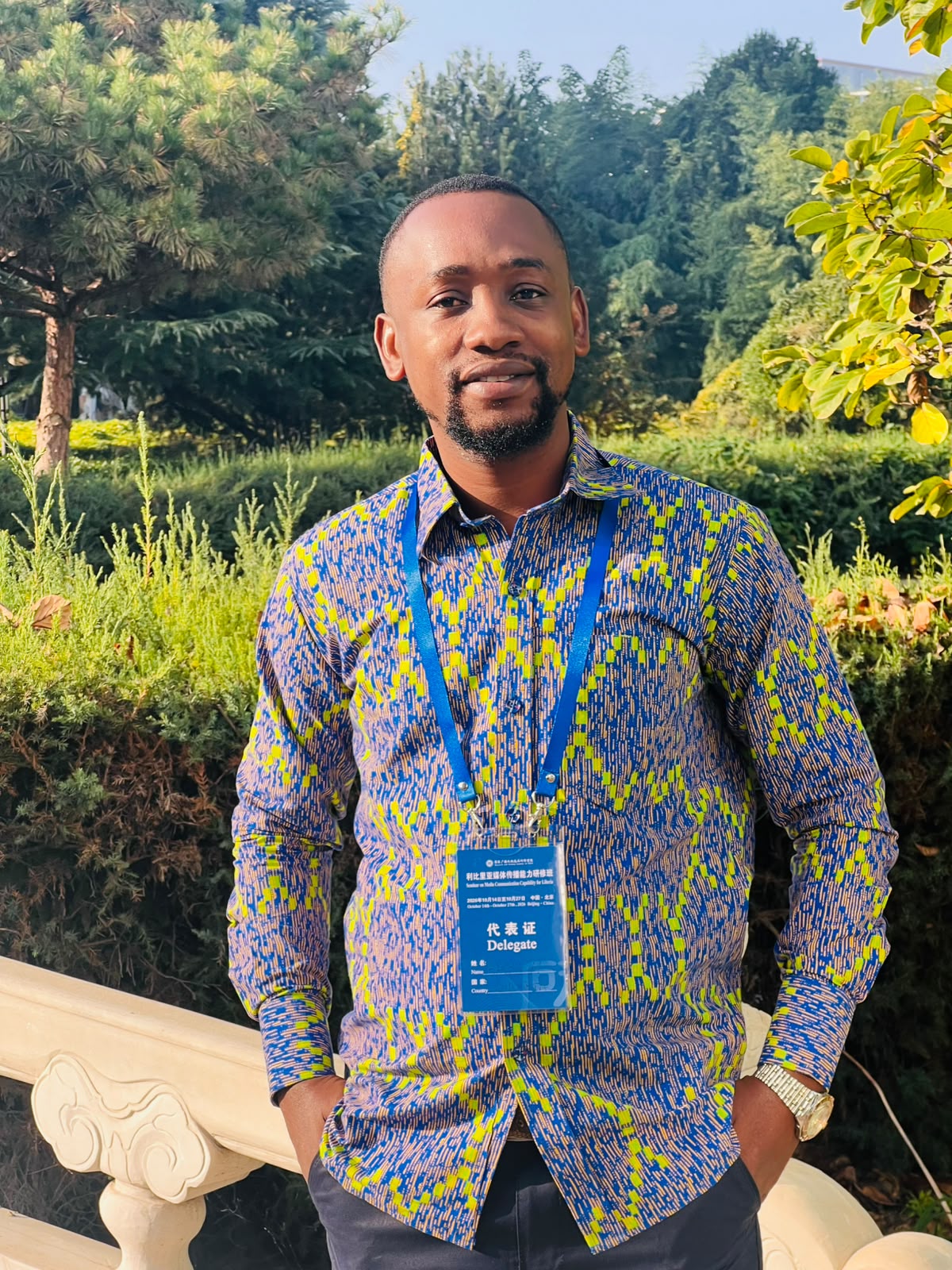
By: Aaron Kubahn
Introduction
When the Chinese Civil War concluded in 1949, approximately 77 years ago, China ranked among the poorest nations on earth. Historical records confirm that by 1950, nearly 90 percent of the Chinese population were subsistence farmers with limited access to education, healthcare, or modern infrastructure. The nation was emerging from a century of conflict and economic collapse.
Today, as a visitor to Beijing, I am witnessing a fundamentally transformed nation. This transformation warrants critical reflection, particularly for developing nations such as Liberia.
Observations from BeijingDuring my training program at the International Training Center in Shunyi, and through visits to historic sites such as the Great Wall of China, the iconic Bird’s Nest built for the 2008 Olympic Games, the China Central Television Tower, Anji County with its mountainous features and its state-of-the-art Smart Governance system, I have observed a level of development that is both rapid and highly organized. This can be seen everywhere in China.
In addition, I observed a seamless high-speed rail network, integrated digital payment systems even in informal markets, world-class urban planning, and a strong culture of public order and civic responsibility. These are not isolated achievements; they are systemic outcomes.
The rapidity of this development is not coincidental. It is intentional.
Three Pillars of Intentional Transformation
My observations point to three pillars that underpin China’s rise under the leadership of the Communist Party of China, and particularly under President Xi Jinping in the past decade:
1. Long-Term Strategic Planning
Unlike many developing countries where development plans are tied to short electoral cycles, China has maintained successive long-term plans — from Five-Year Plans to the Two Centenary Goals. The objective to eradicate absolute poverty, which lifted over 800 million people out of poverty, was articulated, resourced, and systematically executed. The Belt and Road Initiative, the Made in China 2025 strategy, and the rural revitalization program all demonstrate a state that plans 20 to 50 years ahead.In his governance philosophy, President Xi Jinping articulates both the vision and the scale of this mission:
“We have achieved moderate prosperity, the millennia-old dream of the Chinese nation, through persistent hard work. With this, we have elevated China to a higher historic starting point in development.”
He continues by detailing what many economists thought impossible:
“By galvanizing the entire nation to carry out targeted poverty alleviation, we have won the largest battle against poverty in human history. A total of 832 impoverished counties and close to 100 million poor rural residents have been lifted out of poverty, and, among them, more than 9.6 million poverty-stricken people have been relocated from inhospitable areas.”
This is not mere statistics. As I observed in Anji County and other places I visited, I could see real life. The availability of roads, water, electricity, and technology — the main driving forces of economic growth — could be seen and felt.Relocation meant building entirely new communities with housing, schools, clinics, and roads. As President Xi rightly put it, China has “once and for all, resolved the problem of absolute poverty in China, making significant contributions to the cause of global poverty reduction.” For developing countries where poverty remains structural, this model of targeted, data-driven, and fully funded poverty alleviation deserves serious study.
2. Investment in People and Infrastructure
China made a deliberate choice to invest massively in human capital and foundational infrastructure. Universal basic education, vocational training, and expansive road, rail, and digital infrastructure have connected every province and lifted rural areas. This foundation has enabled industrialization and innovation.
3. Discipline and Collective National Effort
The most striking lesson is not in the buildings, but in the people. There is a shared national discipline, work ethic, and commitment to collective advancement. Development is viewed as a national duty, not solely a government responsibility. This cultural cohesion has been essential to executing large-scale national projects.
This would not have been possible if the age-old menace of corruption had been allowed to raise its ugly head. Development funds cannot transform lives if they are diverted.
President Xi addresses this with unusual candor in the same volume. He describes a governing choice driven by a profound sense of responsibility to the people:
“Driven by a strong sense of mission, we have resolved to ‘offend a few thousand rather than fail 1.4 billion’ and to clear our Party of all its ills.”
This principle explains the political will behind China’s comprehensive anti-corruption campaign. Xi further elaborates:
“We have taken coordinated steps to see that officials do not have the audacity, the opportunity, or the desire to engage in corruption, and we have used a combination of measures to ‘take out tigers,’ ‘swat flies,’ and ‘hunt down foxes,’ punishing corrupt officials of all types.”
The outcome, as he notes, is that “we have achieved an overwhelming victory and fully consolidated the gains in our fight against corruption.” This has, in his words, “helped remove serious hidden dangers in the Party, the country, and the military and ensured that the power granted to us by the Party and the people is always exercised in the interests of the people.”
For many developing countries where corruption undermines infrastructure, education, and healthcare projects, this is a critical lesson: development requires not only investment, but protection of that investment from abuse.
Conclusion
China’s journey from a nation of 90 percent farmers in 1950 to a nation that in 2026 hosts professionals from around the world to learn from its experience is not a miracle. It is, as President Xi’s writings demonstrate, the result of persistent hard work, national galvanization, and a willingness to make difficult decisions to protect the interests of 1.4 billion people.
All of this could not have been achieved without a disciplined and diligent people. As I conclude this seminar, I leave with the hope that Africa, specifically my country Liberia, can also rise — but only if we demonstrate the same level of intentionality shown by the Chinese people.My special thanks go to the Chinese Embassy in Monrovia for providing me this opportunity and experience. Also, special thanks to our host, the National Radio and Television Administration, and its staff — Editor David Gao along with his special assistants, Miya Li and Harry Shen. I hope to return, perhaps in a different capacity.
About the Author: Aaron Kubahn is currently the General Manager and Co- Founder of DN News Liberia, a Digital Online News platform with over three Hundred Thousand Followers. A Member of the Liberian Delegation to a Seminar on Media Communications Capability for Liberia in the People’s Republic of China. He holds a Bachelor Degree in Public Administration with over 10 years of active Mainstream Journalism in the Broadcast and Digital media sectors.
